Most bots answer questions nobody asked
A surprising number of bots get built because somebody saw a competitor launch one. The result is usually a menu of features that duplicate the website — same FAQ, same catalog, slower to navigate, and held together with command syntax that nobody remembers. Users open it once and never return. The team blames "engagement" and adds another feature. The cycle repeats until the bot is quietly archived.
Bots fail for the same reason most products fail: they were built around a feature, not around a job. The fix is not better AI or a smoother conversation. The fix is picking a job worth finishing.
A useful bot ends a task
Good bots replace a multi-step process with a single conversation. Pay an invoice, reschedule a delivery, file a support ticket, confirm an appointment. The success metric is not engagement — it is task completion in fewer taps than any other channel. A bot that increases time-on-surface has the metric backwards.
The clearest test we use with clients: write the bot's job in one sentence, ending with a concrete verb. "The bot reschedules a delivery." "The bot renews a subscription." "The bot pays an invoice." If the sentence needs more than one verb, the bot is doing too much.
Three patterns that earn
After enough launches, the patterns that survive are obvious. These three account for most of the ROI we see:
- The async dispatcher. The customer sends a request. A real human picks it up. The bot handles routing, status updates, and confirmations — the operational layer. Useful where the work itself needs human judgement but the orchestration around it does not.
- The status checker. Order updates, shipment tracking, account changes — pushed to the chat, not pulled from a portal. Replaces the "where is my order" support ticket entirely. Pays back in deflection, not engagement.
- The light commerce flow. Repeat purchase, micro-payment, subscription renewal — one tap, one confirmation, done. Lives entirely inside Telegram, never bounces to a browser.
Each of these has a clear ending. The customer's task is finished. The bot did its job and got out of the way.
Three patterns that drain
The mirror image is just as predictable. These do not survive contact with real users:
- The help-center clone. A bot that re-implements your existing FAQ in slower form. The website did this faster, and the search engine did it better.
- The tutorial-required bot. Any bot that needs a "/help" command in the first message has lost. Real users will tap once, see no obvious path forward, and leave.
- The interrogator. A bot that asks questions a database already knows the answer to. The customer has been with you for two years and the bot asks them their name again.
When we audit a struggling bot, at least one of these three is usually the root cause. Removing the failure pattern almost always recovers more engagement than adding a feature would have.
The conversation as a UI
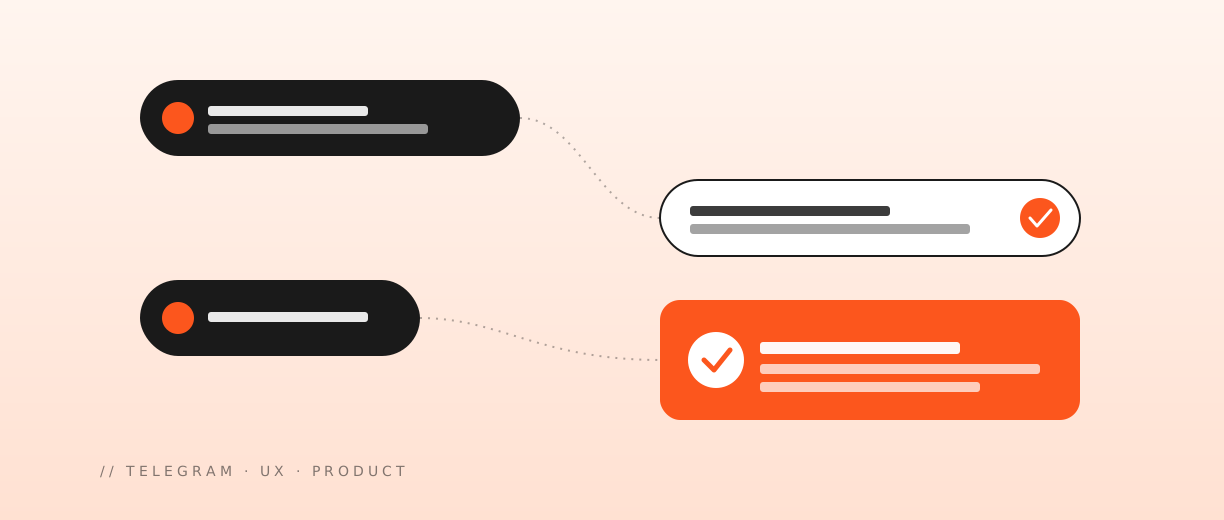
The mistake almost every team makes early on is treating the bot as a chat experience. It is not. It is a UI rendered as messages. The user does not want a conversation — they want an outcome.
This changes how you design everything:
- Buttons over commands. Inline keyboards make options discoverable. Slash commands do not.
- Latency over personality. A response in 300 ms beats a response with a clever opener.
- Predictable shapes. The same kind of question always returns the same kind of card. Surprise is friction in a UI; in a bot, it is friction the user cannot un-trigger.
The best bots feel less like talking to a person and more like tapping through a really fast app.
What we ship in week one
When we build a new bot for a client, the first version is intentionally small:
- One job. The single highest-frequency request from the support inbox.
- One happy path. Five messages from start to finish, including confirmations.
- One escape hatch. A clear way to reach a human, with the user's context attached so they do not have to repeat themselves.
Everything else — analytics, A/B testing, multi-language — comes after the first version is in production for a week. The bots that try to ship the full feature set in v1 almost always need a v2 rewrite. The ones that ship the smallest possible useful thing iterate from a base that is already earning.
The handoff problem
Almost every bot eventually has to hand off to a human. The handoff is where most bots quietly fail. The customer types a question the bot does not understand, the bot loops on "I did not catch that," the customer gives up.
A good handoff has three parts:
- Detection. The bot knows it is out of its depth. Usually a confidence threshold, sometimes a hard rule ("anything about refunds").
- Transfer. The conversation moves to a real human, with the full context attached. The customer does not repeat the question.
- Closure. The human resolves the issue and hands the conversation back to the bot if there is a next step, or closes it cleanly.
Done right, the handoff is invisible. Done wrong, it is the moment the customer churns.
What to measure
Engagement is the wrong metric. The ones that actually correlate with bot health:
- Task completion rate. Of the customers who started a flow, how many finished?
- Time to resolution. From first message to outcome — lower is better, not higher.
- Deflection rate. Support tickets the bot resolved without escalation.
- Return-to-task rate. How many customers came back next month to use the same flow?
If these four are moving in the right direction, the bot is working. If "messages per session" is up and these are flat, the bot is performing — but not earning.
When to retire one
A bot is a product. Products have life cycles. If the underlying task changes — a payment provider moves, a workflow gets simplified, a feature ships on the website — the bot may have lost its job without anyone noticing. Audit yours every quarter and be willing to retire flows that no longer carry weight. A leaner bot is faster, easier to maintain, and more likely to be opened next time.
 Similar news