The channel nobody is looking at
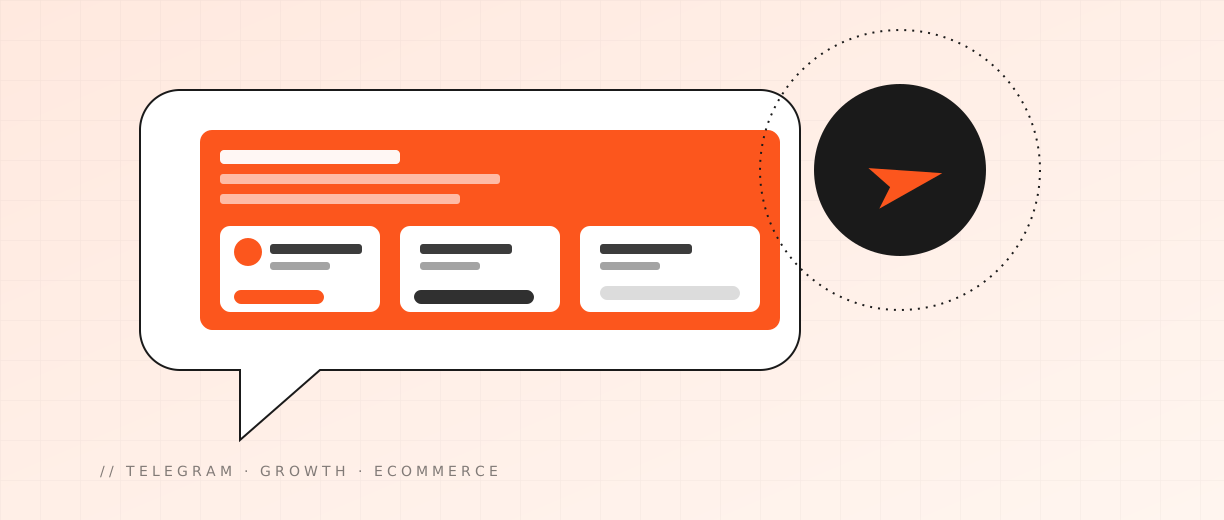
Your customers already have Telegram open. They will not download another app — but they will tap a button inside a chat. Mini Apps remove the install step, the app store review, and the "remember to come back" problem. That is the entire pitch, and it is more powerful than it sounds.
For most teams, the marketing funnel ends with a website visit, a checkout, and a hope that the customer will come back. Mini Apps shift the surface to where attention already lives. You are no longer competing for the customer's screen real estate — you are renting a corner of a conversation they already trust.
Why the channel works mechanically
Three things happen inside a Mini App that do not happen on a regular website:
- Identity is solved. The user is signed in by default. You skip the friction of email, password, magic links, and SSO buttons.
- Notifications cost nothing to deliver. A message in a chat does not need an ad budget, and the open rate is closer to email's worst-case than its best-case.
- Payments are local. Native Telegram payments handle the card on file. The customer never sees a third-party redirect.
Together, these collapse the path from "interested" to "paid" into a handful of taps. The team that gets the flow right reads it as a step-function in repeat revenue, not a marginal A/B win.
What we hear from the teams running them
"We launched a Mini App for a returning-customer flow and saw 4× the conversion of the same offer sent by email. The website still does the heavy lifting for discovery — but Telegram does the closing."
— Head of growth, DTC brand, ~12k monthly orders
Notice what they did not say. They did not say the Mini App replaced the website. They said it took over a specific job — the job of closing a repeat sale — and did it better than the email channel that used to own it. That is the right way to think about the surface.
What sells inside Telegram
After a year of building these, here is the shortlist of patterns that consistently earn:
- Reorder flows. A two-tap path from "I want the same thing again" to "your order is in." The cart, the payment, and the address are all pre-filled.
- Booking and scheduling. Date pickers, time slots, calendar invites, and confirmations — without leaving the chat.
- Loyalty and rewards. Points balance, tier, available offers — pushed when relevant, not buried in an account page.
- Concierge buying. A real conversation with a human, with a Mini App layer underneath for payments, shipping, and contracts.
- Subscription management. Pause, skip, upgrade — three taps, no support ticket.
The common thread: each of these is a task with a clear ending. Mini Apps reward task design. They punish exploratory browsing.
What does not sell
The mirror image is just as important. Skip these or you will burn engineering on a surface that nobody uses:
- A Mini App that re-implements your home page. The website is better at being a website.
- A catalog with thousands of SKUs. Telegram's UI cannot beat a tuned product listing page.
- Content discovery. Search engines exist, Mini Apps do not show up in them.
- Onboarding for cold traffic. Cold visitors need the trust signals a website provides.
The decision matrix
| You have... | Mini App fit |
|---|---|
| A repeat-purchase product | Excellent |
| A loyal customer base on Telegram already | Excellent |
| A booking or scheduling business | Excellent |
| A subscription with frequent management | Strong |
| Lots of SKUs and discovery-driven traffic | Weak |
| Cold-traffic acquisition as the main channel | Poor |
A Mini App is a tool for warm traffic. It compounds the work your website already did. It does not replace it.
What we build first
When a team commissions a Mini App, the first version we ship is almost always the same shape:
- One job. The single most-repeated action across the customer base — usually reorder, renew, or rebook.
- One payment path. Telegram's native payment provider, no third-party redirect, no card collection screen.
- One notification. A single message after the action — confirmation, receipt, or a calendar event.
- One return loop. A way to bring the customer back next time — a saved cart, a reminder schedule, a points balance update.
That version takes two to four weeks. Everything that comes after — catalogs, tiers, support chat, multi-language — gets layered on top once the core loop is shipping revenue.
The engineering you will not read about
Mini Apps look simple on the surface. The work that does not show:
- State sync. Your database is the source of truth, the Mini App is a view. Keeping them in sync across web, app, and Telegram is a real engineering problem.
- Auth bridging. The Telegram user ID is not your user ID. Mapping the two — and handling the case where the customer has both a website account and a Telegram identity — needs a deliberate design.
- Notification budget. Sending too many messages is a faster way to lose a customer than sending none. The cadence has to be product, not marketing.
- Fallbacks. When the Mini App fails — and it will, on a flaky network in a remote market — the user has to land somewhere useful, not on a blank screen.
A Mini App that ignores these is a demo. A Mini App that handles them is infrastructure.
When to launch one
The pattern we see most often: a team launches a Mini App after the website is stable, the email channel is mature, and the support load is predictable. That is the right order. A Mini App built before the basics are in place adds a surface to a problem that is already losing money.
If your business has a repeat customer who already messages you on Telegram — or a marketing channel that already includes Telegram links — you are not late. You are early. The brands winning here are the ones who treated the channel as a real product, not a side project, and shipped the first version in a month.
 Similar news