A landing page is a measurement instrument
The marketing team thinks of a landing page as a creative artefact. The engineering team thinks of it as a static site. Both are wrong. A landing page is a measurement instrument — its primary job is to produce reliable, comparable data about whether a campaign worked. Conversion is the readout. Copy and design are how you tune the instrument.
If you start from that framing, the engineering work falls into place. Every decision answers a simple question: does this make the measurement more or less trustworthy?
Treat the page as a funnel
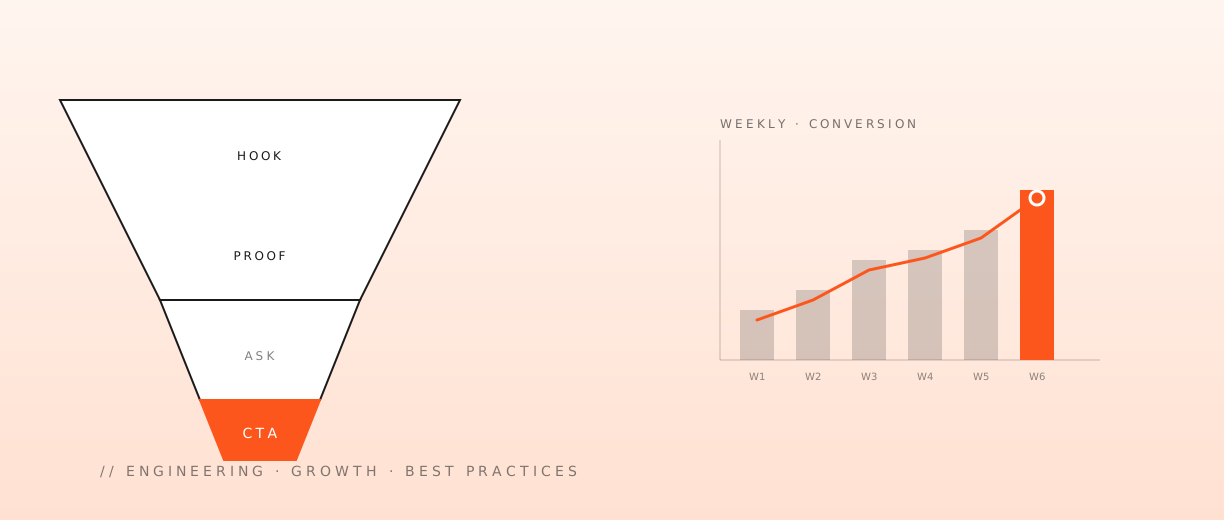
Every landing page is three things stacked: the hook, the proof, the ask. If any one of them is mis-engineered, the next two cannot do their job. The hook fails to LCP, the proof slides past on a janky scroll, the ask never gets a chance to be tapped.
The anatomy in detail:
- The hook. Top of page, visible without scrolling. The largest text, the strongest claim, the only place the reader will look at if they read nothing else. LCP lives here. Performance is a feature of the hook, not a separate concern.
- The proof. Social proof, case studies, numbers, screenshots. The middle of the page where the customer decides whether the hook was honest.
- The ask. The primary CTA. Visible, repeated, frictionless. Every landing page is allowed exactly one ask; everything else is a distraction the customer will read as uncertainty.
If you cannot draw a line around each of these three sections on the page, the page is not a funnel. It is a brochure.
Performance gates everything
The first paint is your hook. Render-blocking scripts, hero images over 200 KB on mobile, and decorative animations that fight the GPU are the three killers we see most often. Fix those first, then talk about copy.
Specific budgets we hold ourselves to on landing pages:
| Metric | Budget | Why |
|---|---|---|
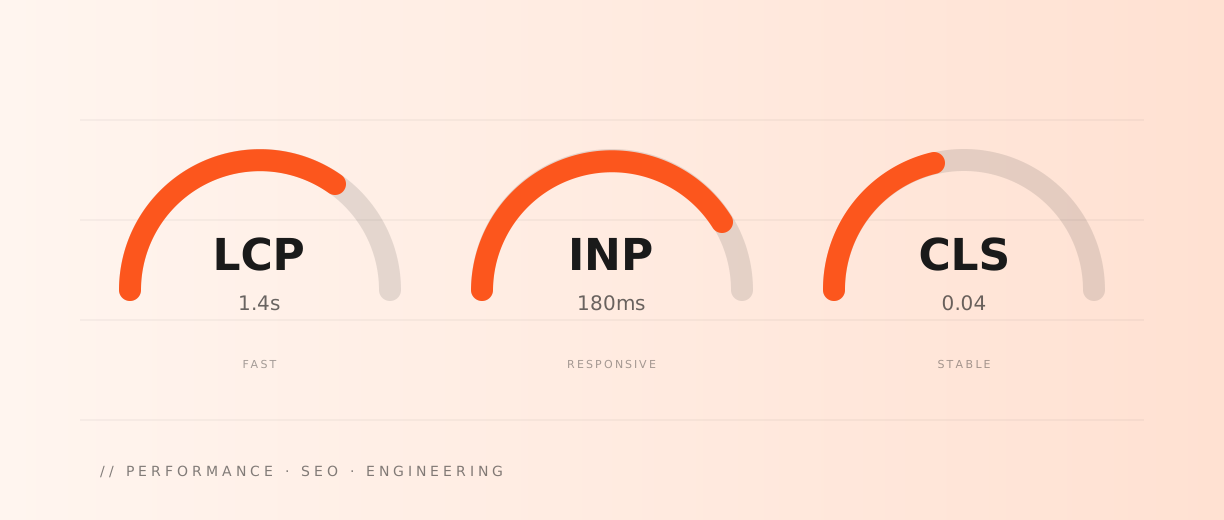
| LCP (field p75) | < 2.0s on mobile | Anything slower drops opens |
| INP | < 200ms | Below the "feels stuck" line |
| CLS | < 0.05 | No layout pops |
| Total JS | < 100kb gzipped | Above this is a maintenance bill |
| Total page | < 500kb on first hit | Anything bigger needs a defense |
These are not aspirational. They are the floor. A page that ships above them will underperform every variation you test, and you will spend months chasing copy changes that cannot move the metric.
The data layer matters more than the copy
Most landing pages cannot tell you what actually converted them. Get the analytics right before the third A/B test:
- A single source-of-truth event for the primary CTA. Not three different ones from three different scripts. Pick one, fire it server-side if possible, name it the same forever.
- UTM parameters preserved through redirects and form submissions. This sounds obvious. It is wrong on roughly half of the landing pages we audit.
- A clean view of bounce, scroll depth, and form abandonment by source. "Where did people stop?" is the most actionable question. Most analytics setups cannot answer it.
- Conversion attribution that survives a return visit. A customer who clicked an ad, left, came back through search, and converted is not an organic conversion. The data layer should know this.
- A server-side fallback. Browser analytics fail more than you think. Critical events fire from your backend, not from the client.
Without this, you are guessing on every iteration. The teams that get the analytics right move faster, even when they ship less.
What the page should not have
The negative space matters. Things we cut from landing pages by default:
- A site-wide navigation that lets the customer leave.
- Footer links to unrelated pages.
- A chat widget that loads on every page.
- Three different testimonial carousels because three different teams added one.
- Cookie banners that take up half the viewport.
- A second CTA that competes with the primary CTA for attention.
Every element on a landing page should pay rent. If you cannot articulate the role it plays in the funnel, delete it.
A weekly improvement loop
The landing page that converts in month six is rarely the page you launched.
Pick one metric. Pick one section. Change one thing. Ship on Tuesday, read the numbers on Friday. Most teams over-design the test plan and under-deliver the test. The opposite scales.
The cadence we use on most clients:
- Monday: Review last week's data. Pick the one section with the largest gap to budget.
- Tuesday: Ship the change behind a flag. 50/50 split with the current version.
- Wednesday-Thursday: Let the experiment run. Resist the urge to peek before you have data.
- Friday: Read the result. If it moved, ship it to 100%. If it did not, kill it.
- Repeat.
A team that runs this loop honestly will out-ship a team that does the same work in monthly batches by a factor of three. The compound effect is enormous.
Variation that works, variation that does not
After enough A/B tests, patterns emerge. The variations that consistently win:
- Stronger, more specific hooks. "Reduce checkout time by 40%" beats "Optimize your checkout."
- Single CTAs. Removing the secondary CTA almost always wins.
- Faster pages. A page that loads 500 ms faster wins more than a page with new copy.
- Trust signals near the ask. Logos, testimonials, security badges — but only near the CTA, not scattered.
The variations that consistently lose:
- New copy without new measurement.
- Decorative animations.
- More form fields.
- A different colour for the CTA without changing anything else.
This is not a creative judgement. It is a pattern that holds across industries, traffic sources, and team sizes.
When to scrap the page
Sometimes the data tells you the page is not the problem — the campaign is. If a landing page has had six honest iterations, the engineering is clean, the metrics are budget-aligned, and conversion is still flat — the page is doing its job. The traffic is wrong, the offer is wrong, or the audience is wrong. Stop iterating on the page and audit the campaign.
The hardest thing about a landing page is knowing when to stop touching it.
What we deliver
When a client commissions a landing page from us, the deliverable is not a design and a build. It is:
- A page that hits the performance budgets above on day one.
- A complete analytics setup with documented events and an audit trail.
- A staging environment where variants can be tested without touching production.
- A first weekly review session, so the team owns the iteration loop.
- A document explaining what we built, why, and how to change it without breaking the measurement.
A landing page without the measurement layer is a brochure. We build instruments.
 Similar news